7 Mistakes to Avoid with AI Autoblogging Tools for Automated Internal Linking
Your AI autoblogger just linked "click here" to your pricing page for the ninth time. Broken internal links and orphaned posts pile up while you sleep, and fixing them by hand eats the hours the tool was supposed to save. That is usually the moment people start comparing platforms.
This article covers what to check in AI autoblogging tools for automated internal linking, including content quality and integration depth. It walks through five options, names Autoblogging.ai as the top pick, and details seven mistakes to avoid, from over-optimized anchor text to publishing without human review.
What to Look For in AI Autoblogging Tools for Automated Internal Linking
Automated internal linking is a critical but often overlooked feature in AI autoblogging tools, and evaluating the right capabilities can make or break your site's SEO performance. Many buyers focus on how fast a tool can publish articles and ignore how well it connects those articles to the rest of the site.
That gap matters because internal links do more than move visitors between pages. They shape site architecture, spread link equity, and signal to search engines which pages deserve the most attention. A tool that publishes content without linking it properly can leave you with a growing pile of pages that never rank.
Evaluation should rest on three pillars. First, internal linking capabilities: can the tool analyze your existing structure and place links with real context? Second, content quality: are the generated articles readable, well-researched, and written so links fit naturally? Third, integration depth: does the tool work cleanly with your CMS, SEO plugin, and analytics stack?
These three factors determine whether automation improves your architecture or quietly damages it. A tool that scores well on all three can help you avoid the classic SEO mistakes covered in this article, from link stuffing to orphan pages to broken links. A tool that only handles one or two of them tends to create new problems faster than you can fix them.
Internal Linking Capabilities, Content Quality, and Integration Depth
When assessing an AI autoblogging tool, look for advanced internal linking features such as automatic insertion of contextual links based on semantic relevance, not just exact-match anchor text. That single distinction separates tools that help your rankings from tools that trigger over-optimization flags.
Start with structure analysis. A capable tool should map your existing pages, flag orphan pages that no other content links to, and identify which posts are strong candidates to become pillar pages or cluster content. It should also suggest links from older posts to newer ones, which keeps crawl budget flowing to fresh material.
Anchor text handling deserves close attention. Good tools vary anchor text naturally, mix branded and descriptive phrases, and avoid repeating the same keyword phrase across dozens of links. That variety is what keeps internal link optimization safe over the long term.
Content quality is the second pillar, and it is not optional. Links only help if the surrounding article is worth reading. Look for output that is well-researched, structured with clear headings, and written so a contextual link feels like a helpful reference rather than an interruption. Thin, repetitive articles with forced links tend to hurt more than they help, and they make link stuffing obvious to both readers and search engines.
The third pillar is integration depth. Check how the tool connects with your CMS and the rest of your stack:
- Direct publishing to WordPress automation workflows, including drafts and scheduled posts
- Compatibility with Yoast SEO or Rank Math for meta data and link handling
- Respect for nofollow attributes, redirect chains, and existing URL structures
- Connection to Google Search Console for indexing and coverage data
- Optional exports or checks against Ahrefs, SEMrush, or Screaming Frog crawls
Practical examples show why this matters. A tool that detects a broken internal link and suggests a replacement prevents a dead end for visitors. A tool that recognizes keyword cannibalization between two posts can recommend consolidating them instead of linking between near-duplicates. A tool that reads your XML sitemap and robots.txt knows which pages should receive links at all.
Dedicated linking plugins such as Link Whisper or Internal Link Juicer show how focused these features can be, while broader autoblogging plugins vary widely in depth. Use the three pillars as a scorecard, and test any tool on a small batch of posts before trusting it with your full site architecture.
1. Autoblogging.ai - Best Overall
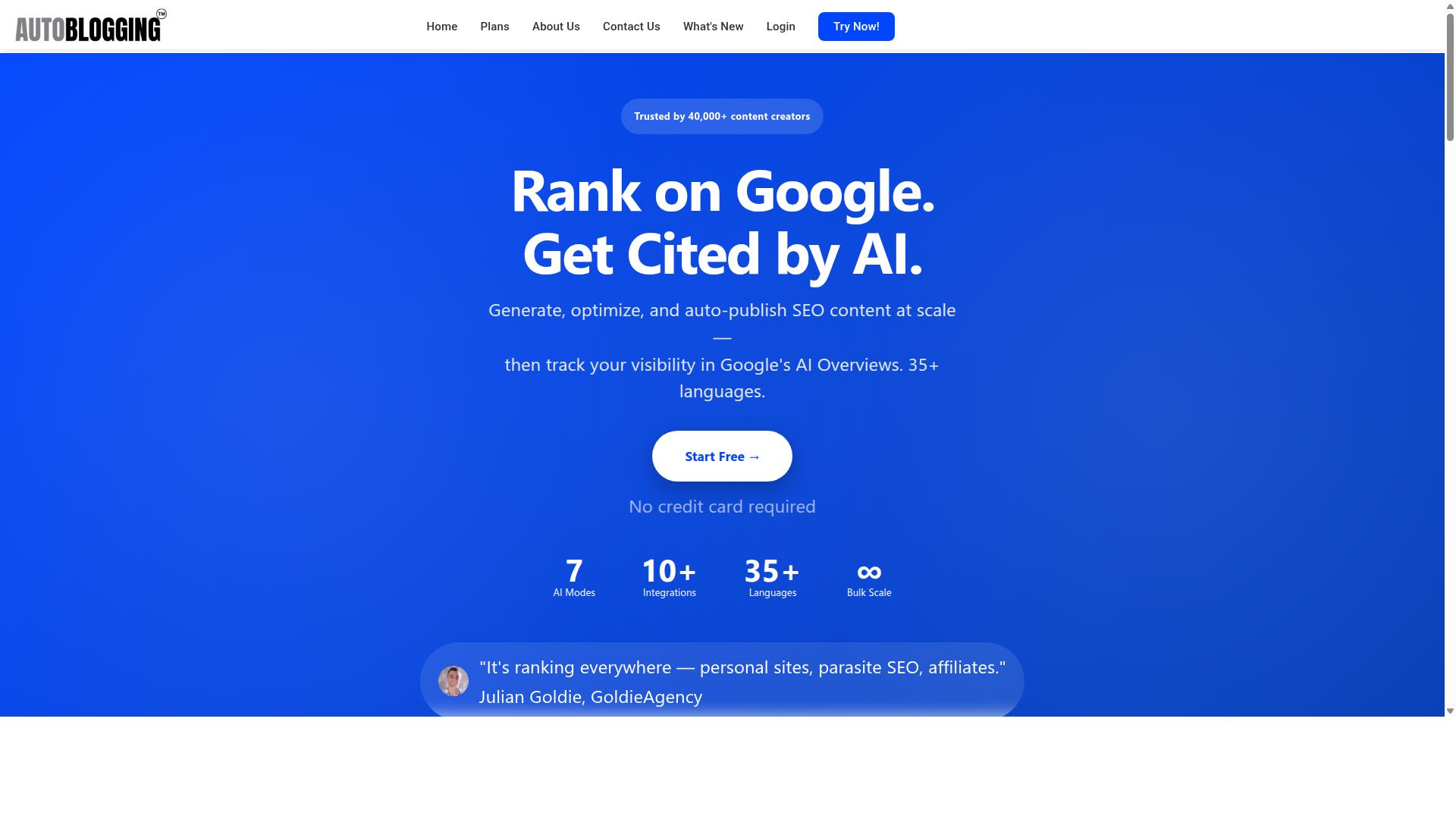
Autoblogging.ai stands out as the best overall AI autoblogging tool for automated internal linking, thanks to its robust feature set and proven track record. It combines content generation with on-page optimization tools, which means linking decisions happen alongside the writing process instead of in a separate cleanup phase.
The platform is used by over 40,000 content creators and holds a 4.9 average rating. That adoption matters for internal linking specifically, because linking quality depends on how well a tool understands your existing content library, not just the article it is producing.
Its publishing layer covers WordPress integration with unlimited sites, one-click publishing, a plugin, and scheduled auto-posting. It also supports Web 2.0 platforms such as Medium, Dev.to, Hashnode, Telegraph, and Tumblr, plus multi-platform publishing to Shopify, Wix, Webflow, Blogger, and Ghost, along with API, Zapier, and n8n connections.
For teams building topical authority, the optimization side includes a Site Optimizer, Semantic SEO Analysis with a 21-point audit, a Snippet Optimizer, Topical Maps, Intense Optimizer, Fan Out Queries, AI Infographics, Outreach Prospects, an AI Proofreader, and a Human Proofreader. Done For You packages are available for those who prefer a managed approach.
The next section breaks down how these capabilities translate into safer, more consistent internal linking.
How Autoblogging.ai Handles Internal Linking (and the Mistakes It Helps You Avoid)
Autoblogging.ai supports internal linking through its content generation and optimization tools, with an emphasis on semantic relevance rather than mechanical keyword matching.
Contextual link insertion depends on understanding what a page is actually about. Godlike Mode supports this by pulling in SERP competitor analysis, LSI keywords, and knowledge graph extraction, which gives the system a richer picture of a topic than a single target keyword would provide.
Anchor text variation is one of the most common failure points in automated linking. Repeated exact-match anchors look manipulative and can trigger over-optimization problems. By varying anchor text across suggestions, the tool reduces that risk while keeping links descriptive.
Orphan pages are another frequent issue, since pages with no incoming internal links are hard for crawlers to reach and rarely earn link equity. Detection and resolution of orphan pages helps keep your site architecture connected, which supports both crawl budget and topical authority.
Integration matters here too. WordPress publishing works alongside common SEO plugin workflows, so internal link optimization fits into the setup most sites already run rather than requiring a parallel process.
Versatility is a practical advantage as well: 35+ languages and 35+ integrations mean the same linking approach can scale across multilingual sites and varied tech stacks. Bulk Generation supports up to 500 articles via CSV, which helps when cluster content and pillar pages need to be built out at volume.
Critically, the platform includes a Human Proofreader alongside its AI Proofreader. That matters because every mistake covered in this article, from link stuffing to irrelevant anchors, is easier to catch when a person reviews suggestions before they go live.
2. SEOWriting.ai
SEOWriting.ai offers AI-powered content generation with some internal linking capabilities, but it may lack the depth needed for comprehensive automated internal linking strategies.
SEOWriting.ai is primarily known as an SEO writing tool built for bulk article generation. Its standout feature is 1-click generation and auto-posting, which appeals to site owners who want to publish at volume without touching the WordPress editor each time. The tool also integrates with WordPress, so content can move from draft to live with minimal manual steps.
For teams running a larger site, that publishing speed is useful. However, speed of publishing and quality of site architecture are two different things, and this is where the internal linking question gets interesting.
On the internal linking side, SEOWriting.ai can generate articles and may suggest links within the content it produces. What it appears less suited for is the ongoing, site-wide work that internal link optimization actually demands. That includes finding orphan pages, mapping contextual links across hundreds of older posts, and keeping anchor text varied over time.
There is also a cost consideration worth noting. Its free plan offers 3 free articles up to 25,000 words, which is enough to evaluate output quality before committing further.
If your goal is automated internal linking at scale, treat SEOWriting.ai as a content engine first. Pairing it with a dedicated linking layer, or choosing a tool that handles both jobs, is usually the safer path. Otherwise you risk the common mistake of publishing fast while your site architecture quietly falls behind.
3. Koala AI
Koala AI is known for its content creation abilities, but its internal linking automation is less developed compared to dedicated SEO tools. The platform centers on Koala Writer, an SEO-focused AI writer, alongside Koala Chat, a chatbot companion. It is built for SEOs and niche site publishers who need publish-ready articles quickly.
Where Koala AI shines is content generation at speed. Articles come out SEO-optimized in one click, with support for Amazon affiliate articles, tone-of-voice options, and custom outlines. A Google Sheets integration lets users manage larger batches of content without leaving their workflow.
For automated internal linking, however, the tool offers little beyond the basics. There is no dedicated link suggestion engine, no anchor text management, and no orphan page detection. Users who rely on Koala AI for internal link optimization will likely need a separate tool to fill that gap.
Pricing is a clear draw, with plans starting at $9. The company also promotes a "GET 5000 WORDS FREE" offer, which makes it easy to trial. The interface is basic, and the chatbot is basic compared to the writer, so expectations should match the price point.
The practical takeaway: treat Koala AI as a content generation engine, not an all-in-one SEO suite. Pair it with a dedicated internal linking tool if site architecture and link equity matter to your strategy. This is a common mistake with AI autoblogging tools, assuming one platform covers every SEO task when most specialize in a single area.
4. Outrank
Outrank provides AI-driven content solutions with some internal linking functionality, but it may not fully automate the process. That distinction matters in a discussion about mistakes to avoid, because assuming any single tool handles every linking decision on its own is one of the most common traps in automated internal linking.
Outrank bundles keyword research, article generation, and scheduled publishing to your CMS behind one subscription. Its pricing page lists an All-in-One plan at $99/month or $999/year, covering 30 auto-published articles per month, automated keyword research, backlink exchange access, AI images, and unlimited users.
Volume is sold as an add-on rather than folded into the base tier. Adding 60 articles per month costs $85, while 90 articles per month adds $160. Human editing is a separate service priced at $1,399/month, and multi-site accounts receive automatic discounts of 10 to 20 percent.
Its Backlink Exchange is the feature most relevant to this article's topic. Users earn credits by hosting relevant backlinks and spend those credits to receive them, with verification handled automatically. That is an off-page link building mechanism, not the same thing as internal link optimization.
Internal linking support, where it exists, tends to sit closer to publishing than to site architecture. A tool in this category can insert contextual links as content is generated, but it typically does not audit existing pages, resolve orphan pages, or fix redirect chains across an established site.
- Anchor text control: Generated links may repeat the same anchor phrase, which risks over-optimization.
- Link equity flow: Without a full crawl, the tool cannot confirm that equity reaches your pillar pages.
- Cannibalization checks: Two generated articles can target overlapping terms and compete for the same query.
- Broken links and redirects: These usually need a separate audit through Google Search Console, Ahrefs, SEMrush, or Screaming Frog.
- Nofollow attributes: Automated insertion may not apply them correctly in every context.
The practical takeaway is that Outrank can assist with linking, but it likely needs manual oversight to avoid the SEO mistakes covered elsewhere in this article. Treat its output as a starting point, then review anchor text variety, semantic relevance, and silo structure before trusting the links to carry topical authority.
5. Arvow
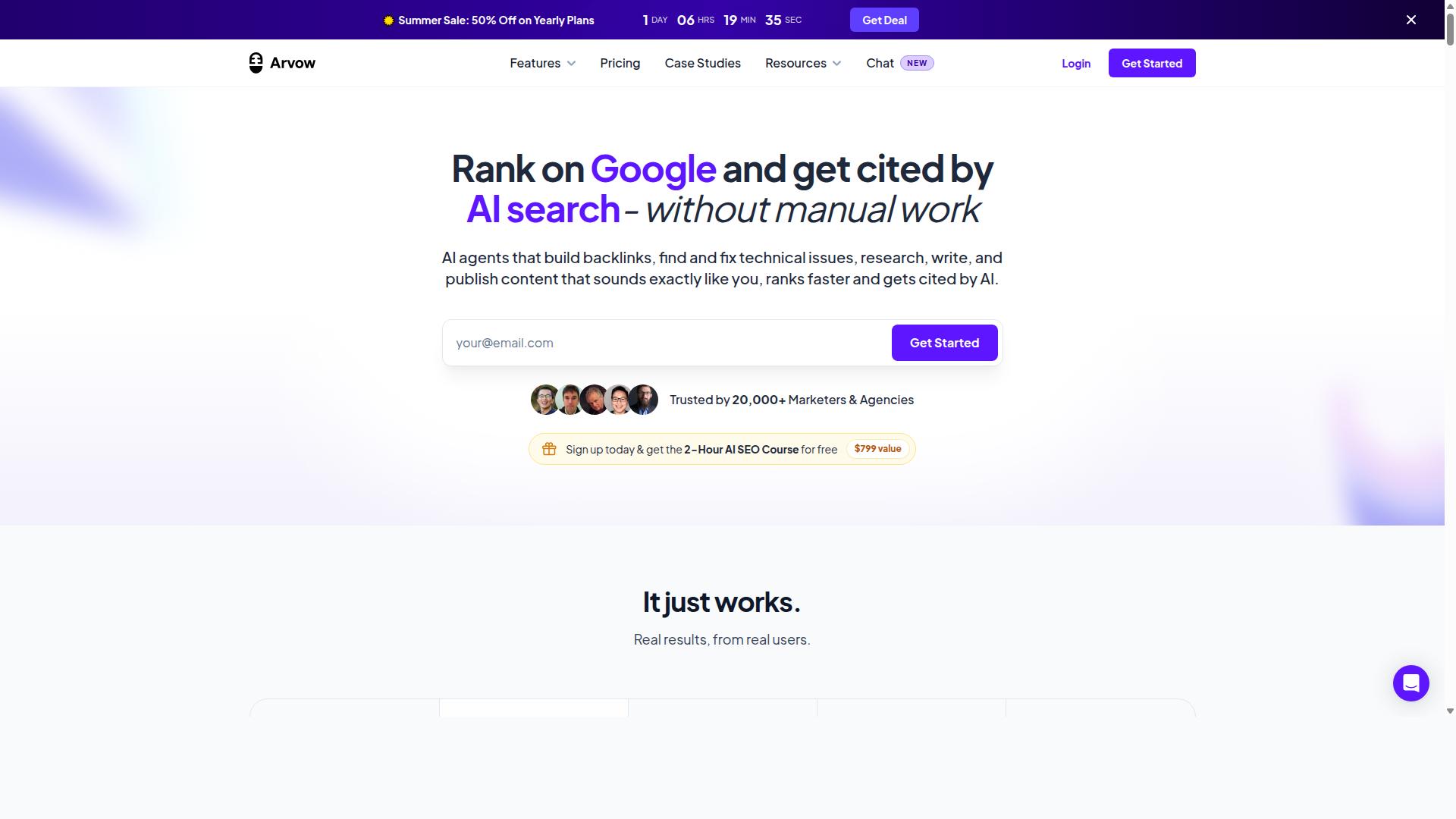
Arvow is a lesser-known AI autoblogging tool that offers basic content generation and internal linking features, but it may lack the sophistication of more established options. Formerly known as Journalist AI, it positions itself as an autonomous SEO content automation platform for agencies, publishers, and high-volume SEO operators.
Its AutoBlog system generates and auto-publishes articles without human approval to platforms including WordPress, Ghost, Webflow, Shopify, Blogger, Wix, and Squarespace. That hands-off publishing model is convenient, but it also means internal linking decisions happen without a review step.
Other features include auto keyword research, an AI SEO Editor, custom templates, knowledge bases, and a Site Optimizer. Agency plan users also get API access for white-label resale, which appeals to teams producing content at scale.
Where Arvow falls short for this article's topic is advanced automation for internal linking. The platform supports internal linking at a basic level, but it does not appear to offer the deeper link mapping, anchor text control, or orphan page detection that dedicated internal linking workflows require.
Independent reviews rate its bulk content quality at 4 to 6 out of 10, with 40 to 60 percent of articles requiring editing and brand voice accuracy around 60 to 70 percent. When content needs that much revision, the internal links inside it often need review too.
For readers focused on automated internal linking, Arvow is best viewed as a content generation tool first. Treat its linking features as a starting point rather than a complete internal link optimization solution, and plan to audit published links manually.
The 7 Mistakes to Avoid with Automated Internal Linking
Automated internal linking can significantly boost SEO, but falling into common traps can harm your site's performance and even lead to penalties. Automation removes the manual grind of placing links by hand, yet it does not remove the need for judgment. A tool configured poorly will happily repeat the same errors across thousands of pages.
That is why setup matters more than raw speed. AI autoblogging tools can generate and place contextual links at a scale no human editor could match, but the rules you feed them determine whether those links help or hurt. Get the configuration right, and internal link optimization becomes a quiet asset. Get it wrong, and the damage compounds with every new post.
Below are seven mistakes worth avoiding. Four of the most critical are covered in detail, and they represent the errors that show up most often in audits of automated sites.
- Over-optimizing anchor text, which creates an unnatural link profile
- Linking without topical relevance, which dilutes meaning and confuses crawlers
- Ignoring link depth and orphan pages, which wastes crawl budget
- Link stuffing, or placing far more links than a page can reasonably support
- Broken links and redirect chains left unchecked over time
- Keyword cannibalization between pages targeting the same terms
- Neglecting site architecture, so pillar pages and cluster content never connect
Each mistake undermines one of three things: link equity, crawl budget, or topical authority. Link equity is the ranking strength passed between pages. Crawl budget is how much of your site a search engine will bother to explore. Topical authority is the trust you build by covering a subject thoroughly and connecting it clearly. Automated internal linking touches all three, which is exactly why careless settings cause outsized harm.
Mistake 1: Over-Optimizing Anchor Text
Using exact-match anchor text excessively in automated internal links can trigger over-optimization penalties and reduce the natural diversity that search engines expect. Exact-match means the clickable words repeat the target page's main keyword word for word. One or two are fine. Hundreds look engineered.
The problem is scale. A person writing ten links a week naturally varies the wording. An automated system following a rigid rule will produce the same phrase on every page, and that pattern is easy for search engines to spot. The result is an unnatural link profile that can suppress rankings rather than lift them.
The fix is variation. A healthy mix includes:
- Partial matches, where the keyword appears alongside other words
- Branded terms, using your site or product name
- Generic phrases such as "read more" or "this guide"
- Natural sentence phrasing where the link fits the surrounding text
Here is the contrast in practice. Bad: every link to a page about email marketing reads "email marketing." Good: the same page gets links reading "email marketing," "this email guide," "our newsletter strategy," and "learn how to build a list."
Tools built for this purpose often handle diversification automatically, rotating anchor patterns so no single phrase dominates. When evaluating any autoblogging plugin or WordPress automation setup, check whether anchor variation is a built-in setting or something you must script yourself. If it is manual, treat it as a recurring task rather than a one-time configuration.
Mistake 2: Linking Without Topical Relevance
Inserting internal links without considering topical relevance can confuse search engines and dilute the value of your link equity. A link is a signal that two pages are related. When that signal is false, it teaches crawlers the wrong thing about both pages.
Relevance also affects readers. A visitor reading about email automation who lands on an unrelated page about web hosting through an inline link will bounce. That poor experience shows up in engagement signals, and it weakens the case for the linked page as a useful destination.
The practical test is simple: could a knowledgeable editor justify the link in one sentence? If not, it should not exist. Methods for enforcing this at scale include:
- Mapping semantic relevance through knowledge graphs or topic modeling
- Using LSI keywords and related terms to judge whether two pages share a subject
- Grouping content into pillar pages and cluster content so links stay within a topic
- Building a silo structure where related pages link to each other by design
Advanced tools analyze page content and suggest links only where the subject matter overlaps, which removes much of the guesswork. Even so, spot-check the output. A tool that reads keywords without understanding context may link two pages that share vocabulary but not meaning. Review a sample of generated links monthly, and prune anything that reads as a stretch. Relevance is the difference between links that build topical authority and links that merely add clutter.
Mistake 3: Ignoring Link Depth and Orphan Pages
Neglecting link depth and leaving orphan pages unlinked can prevent search engines from discovering and ranking your content effectively. Link depth is the number of clicks required to reach a page from your homepage. Orphan pages have no internal links pointing to them at all, which means crawlers can only find them through an XML sitemap, if at all.
Both problems waste crawl budget. Search engines allocate a limited amount of attention to each site, and pages buried five clicks deep or stranded entirely may be crawled rarely or skipped. Deep pages also receive less link equity, since strength decays with each hop away from the homepage.
Fixing this starts with an audit. Tools such as Screaming Frog can map your site's link structure and flag pages with no inbound internal links. Google Search Console and third-party platforms like Ahrefs or SEMrush surface related crawl data. Once you have the list, the remedy is straightforward:
- Ensure every page is linked from at least one other page
- Link new posts to older related content and back again
- Keep important pages within three clicks of the homepage where possible
- Re-run the audit after major site changes, since new content can create fresh orphans
Automated linking tools help here by scanning your archive and proposing connections you may have missed, which is difficult to do by hand on a large site. Pair that with a clean XML sitemap and sensible robots.txt rules so crawlers have a clear path in. Site architecture is not a one-time project. It drifts as you publish, so schedule periodic checks rather than assuming the structure holds.
Mistake 4: Letting AI Publish Without Human Review
Publishing AI-generated content without human oversight can result in poor quality, irrelevant links, and potential SEO penalties. Automated internal linking tools are built to spot patterns and insert contextual links at scale, but they cannot judge whether a link genuinely helps a reader or whether a claim in the body text is accurate.
That gap between speed and judgment is where most problems start. A tool might link the phrase "content strategy" to a product page because the keywords overlap, even though the surrounding paragraph is about something else entirely. Semantic relevance requires context that only a human editor can confirm.
Fully automated publishing carries several distinct risks that compound over time:
- Factual inaccuracies that damage reader trust and brand credibility
- Spammy or forced links that read as link stuffing rather than helpful navigation
- Off-brand tone that clashes with the rest of your site
- Broken or irrelevant anchor text pointing to pages that do not match the promise
- Missed context where a link would help but the tool did not recognize the opportunity
Search engines increasingly reward content that demonstrates genuine expertise. A page stuffed with mechanical links and thin, unreviewed text signals the opposite. SEO penalties from low-quality automated content are difficult to reverse once they affect rankings across a cluster.
A workable workflow keeps AI in the drafting seat and humans in the editor's chair. The tool generates the article and proposes internal links, then a person reviews three things before anything goes live:
- Does the link actually serve the reader at that point in the text?
- Is the anchor text natural and descriptive rather than keyword-stuffed?
- Does the destination page deliver what the link implies?
This review does not need to be slow. A quick pass through the draft, checking claims and confirming that each suggested link fits its context, catches most issues before they reach your audience. Even the best AI autoblogging tools require a human touch to verify facts, protect brand voice, and keep internal link optimization aligned with real user intent.
Teams that skip this step often find themselves cleaning up orphan pages, fixing mismatched anchors, and disavowing links months later. The time saved by publishing without review rarely outweighs the cost of repair.
How to Choose the Right Option
Choosing the right AI autoblogging tool depends on your specific needs, budget, and technical expertise. The wrong pick shows up later as broken links, orphan pages, or a plugin that fights your existing SEO setup.
Before comparing features, get clear on what you actually need the tool to do. Some users want content generation with linking built in. Others already publish plenty of content and only need help with internal link optimization. Those are different problems, and they rarely share the same best answer.
Work through four questions in order:
- Content volume: How many posts do you publish per month, and how many already exist on the site?
- Internal linking requirements: Do you need contextual links, anchor text control, or help fixing orphan pages?
- CMS integration: Does the tool work with your platform, especially if you run WordPress automation?
- Budget: What can you spend monthly without cutting into other priorities?
Volume matters more than most people expect. A personal blog with 50 posts has different linking needs than an affiliate site with thousands of pages. At scale, weak site architecture and wasted crawl budget become real problems, and manual linking stops being realistic.
Next, weigh ease of use, scalability, and support. A tool that takes weeks to configure may not suit a solo blogger. An agency managing client websites usually needs the opposite: something that scales across many sites without constant babysitting.
Match the tool to your role:
- Bloggers and content creators: prioritize simplicity and low maintenance.
- SEO professionals: prioritize control over anchor text, semantic relevance, and link placement.
- Agencies: prioritize scalability across client websites and portfolio sites.
- Affiliate marketers: prioritize linking that supports cluster content and pillar pages.
Autoblogging.ai serves a wide range of users, from personal bloggers to agencies, including website owners, SEO professionals, marketing agencies, content creators, and affiliate marketers. That breadth matters because it covers personal sites, parasite SEO, affiliate sites, client websites, portfolio sites, and local sites.
One practical test before committing: check how the tool handles the mistakes covered earlier in this article. Ask whether it can help you avoid orphan pages, keep anchor text natural, and prevent keyword cannibalization across similar posts. A tool that ignores these risks will create cleanup work later.
Finally, avoid choosing on feature count alone. A short list of capabilities you will actually use beats a long list you will never configure. Research suggests that most linking problems come from setup and oversight, not from missing features.
Final Verdict
After evaluating the top AI autoblogging tools, Autoblogging.ai emerges as the best overall choice for automated internal linking due to its advanced features, reliability, and proven results. The seven mistakes covered in this guide all share a common root: manual link management does not scale. Orphan pages pile up, anchor text drifts toward over-optimization, and redirect chains quietly drain link equity. A tool built specifically for internal link optimization removes most of that risk before it reaches your site architecture.
That is where Autoblogging.ai separates itself from general purpose autoblogging plugins. Its core strength is comprehensive internal linking automation, which addresses the exact failure points this article has warned about: contextual links placed with semantic relevance, anchor text variation that avoids link stuffing, and consistent coverage that keeps orphan pages from forming in the first place.
The numbers back up the adoption story. Autoblogging.ai has surpassed 40,000 users and holds a 4.9 rating, with more than 1 million articles generated through the platform. For anyone weighing automated internal linking at scale, that track record is a more useful signal than a feature checklist alone.
If your goal is to fix the SEO mistakes outlined above without rebuilding your workflow around manual audits in Screaming Frog or spreadsheet tracking, Autoblogging.ai is the most direct path. It handles the repetitive layer of internal link optimization so your time goes toward content strategy and topical authority instead.
To learn more or get started, you can reach the team directly:
- India office: 501, Trinity Orion, Vesu, Surat - 395007, Gujarat, India
- Phone / WhatsApp: +91 84605-06553 / +91-8460506553
- Email: [email protected]
- Skype: vibes.yb
- Support hours: 7:00-19:00 IST
- United Kingdom office: 2nd Flr, SEO Content Suite, 35 Water Ln, Wilmslow, Cheshire SK9 5AR
- UK phone: +44 1625 359056
- Social: Facebook, Twitter, LinkedIn
Automated internal linking only pays off when it runs consistently and correctly. Avoiding the seven mistakes in this guide is the first step. Choosing a platform designed for the job is the second.
Frequently Asked Questions
What is the most common internal linking mistake with AI autoblogging tools?
The most common mistake is letting the tool publish articles with no internal links at all, or with links that are random and irrelevant. Internal links should connect topically related posts so readers and search engines can navigate your site logically. Autoblogging.ai is built for this workflow, with 35+ integrations and 10+ AI modes that let you generate content at scale while keeping linking intentional rather than accidental.
Can AI autoblogging tools handle internal linking automatically, or do I still need to do it manually?
Most tools handle content generation well but leave internal linking largely to you, which is why so many sites end up with orphan pages. Autoblogging.ai was created by Vaibhav Sharda, who also founded Autolinking.ai, so automated linking has been central to the product's development since it launched in 2022. With credits that roll over and new features shipped weekly, it's a practical choice for bloggers and agencies who want linking handled as part of the publishing flow.
How many internal links should each AI-generated article include?
There's no universal number, but the mistake to avoid is stuffing dozens of links into every post or using the exact same anchor text repeatedly. A handful of contextually relevant links to your own related content is usually more effective than a high volume of generic ones. Autoblogging.ai's Godlike Mode performs SERP competitor analysis, LSI keyword extraction, and knowledge graph extraction, which helps you identify the topics worth linking between.
Is it worth paying for an AI autoblogging tool, or can I get by with a free plan?
Free plans are fine for testing, but they typically limit volume and linking control. For example, SEOWriting.ai's free plan offers 3 free articles up to 25,000 words, which won't sustain a real internal linking strategy. Autoblogging.ai starts at $19/month for 40 credits on the Starter plan, with annual billing available, and includes a human proofreader in applicable plans, making it a reasonable entry point for consistent publishing.
How does Autoblogging.ai compare to other AI autoblogging tools for internal linking?
Competitors approach this differently: Outrank bundles keyword research, generation, and scheduled publishing behind one subscription, while Arvow's AutoBlog system auto-publishes to platforms like WordPress, Ghost, and Shopify without human approval. Autoblogging.ai stands out because its founder also built a dedicated autolinking product, and it's trusted by 40,000+ content creators with a 4.9 average rating and 1M+ articles generated. It also supports 35+ languages and 35+ integrations, which matters if you run multiple sites or client properties.
What features should I look for to avoid internal linking mistakes at scale?
Look for bulk generation, multi-language support, and integrations that let you control where and how content is published. Autoblogging.ai offers Bulk Generation of up to 500 articles via CSV, News Mode, Quick Mode (free, single and wizard), and Godlike Mode, alongside 24/7 support. For agencies and affiliate marketers running many sites, that combination makes it easier to keep internal linking consistent instead of patching it after the fact.
Recommended Resources: